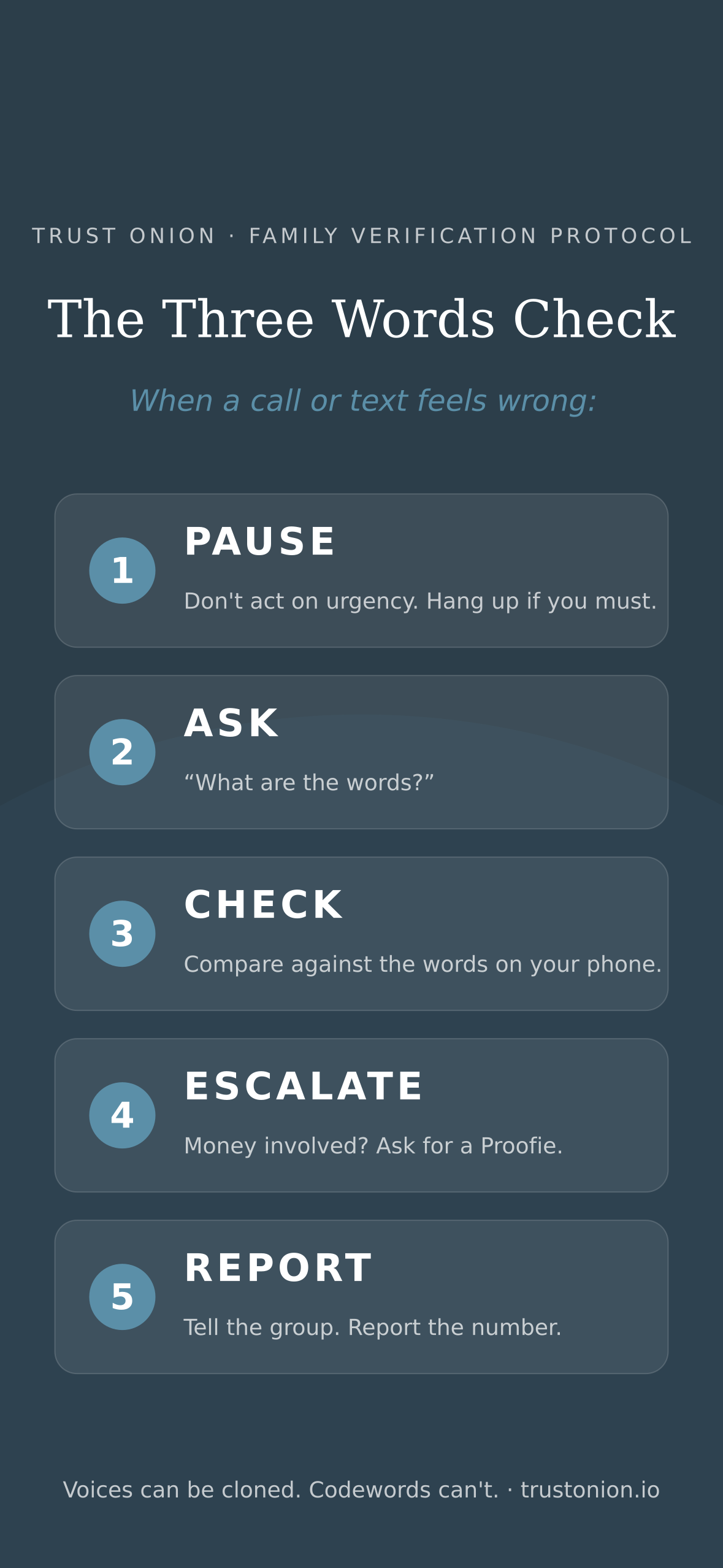
The Three Words Check
A five-step verification protocol families, seniors, and clubs use when a call or text feels wrong. Free to use, free to share.
AI can clone a loved one's voice from a three-second clip. It can copy their texting style, their photo, even their face on a video call. What it cannot do is know a private secret that changes every 60 seconds and never leaves your family's phones.
The Three Words Check is a simple protocol built on that fact. Every member of your family, friend group, or club sees the same three rotating codewords on their phone. When any call, text, or message asks for money, passwords, or urgent action, you run the check — five steps, under a minute — before you act. The codewords come from Trust Onion, a free app for iPhone and Android with no account required, and the words are generated on each device so there is no server to hack and nothing to intercept.
The protocol works because it replaces the question scammers can beat — "does this sound like them?" — with one they can't: "do they know something only they could know right now?"
1Pause
Every impersonation scam runs on manufactured urgency: an accident, an arrest, a locked account, a deadline in minutes. Urgency is the tell, not a reason to hurry. Say "I'll call you right back" and hang up, or stop replying to the text. Nothing legitimate is lost by taking sixty seconds — a wire transfer or gift card, once sent, is usually gone for good.
2Ask
Ask the one question a clone can't answer: "What are the words?" Anyone genuinely in your group can open their app and read off the three current codewords. A scammer — even one with a perfect voice clone, your relative's photo, and a convincing story — cannot.
3Check
Open your own phone and compare. All three words must match the current rotation. "I don't have my phone," "the app isn't working," or two out of three is a fail. The words rotate on a timer, so even a codeword overheard yesterday has already expired.
4Escalate
When money, passwords, or someone's safety is on the line, ask for a Proofie™. A Proofie™ is a selfie signed using your passkey in the Trust Onion app. Use the app to send and verify Proofies, compare the signing key against the person's full public key in your shared group, and check that the exact original photo has not changed since it was signed. The cryptographic signing identity is the full public key, not its shortened label. Compare the verified full signing key with the person's public key in your shared Trust Onion group. This does not automatically verify a real-world identity or detect AI-generated images. The setup guide explains how Proofies work.
Public by default, under your control. Proofie photos and signed records are stored securely on Amazon Web Services (AWS). A Proofie is public by default: anyone with its link or QR code can view the photo and signed record. You can add a password to make a Proofie private, or delete it at any time. Deleting a Proofie removes its photo and signed record from our AWS storage and takes its link offline, but cannot recall copies someone has already downloaded or saved.
5Report
A failed check isn't the end — it's intelligence. Warn the rest of your group immediately so nobody else takes the same call. Block the number, then report the attempt to the FTC at reportfraud.ftc.gov and, if money was lost, to the FBI at ic3.gov. You can also see how these scams play out in our real case studies and news tracker.
The midnight "daughter" call
Your phone rings at 11 PM. Your daughter, sobbing: car accident, needs $5,000 for a lawyer, right now. The voice is hers. You say, "Honey, what are the words?" Silence, then excuses. You hang up, call her real number — she's asleep at home. The panic was real; the daughter wasn't.
The grandparent scam
A grandson calls his grandmother: he's been arrested on vacation, bail must be wired quietly, "don't tell Mom." She reads the card taped next to her phone: Pause. Ask. Check. She asks for the words. The caller pushes harder about urgency — which, she remembers, is exactly the tell. She hangs up and calls her daughter instead.
The club treasurer switch
The cycling club's group chat gets a message from the "treasurer" — same name, same photo: dues now go to a new bank account, today. One member replies: "What are the three words?" No answer. The real treasurer, verified with matching words, confirms nothing changed. The club set up their group in one pre-ride meetup.
- Trusting the voice or the photo. The whole reason the protocol exists is that voices, faces, and writing styles can now be faked convincingly. Verify knowledge, not sound.
- Skipping the check because "it's obviously them." The scams that succeed are the convincing ones. Run the check especially when it sounds exactly like your relative.
- Accepting a partial answer. Two words out of three, an old rotation, or "you know I'm bad with the app" all count as a fail. The protocol only works if a fail means stop.
- Letting urgency override the protocol. "There's no time" is the script every scammer uses. Real emergencies survive a sixty-second verification.
- Keeping a failed check to yourself. Scammers work through the whole family list. If you got the call, your parents are probably next — warn the group.
- Using a single static safe word. One fixed word can leak once and be reused forever. Rotating codewords expire on their own — see family safe word vs. rotating codewords.
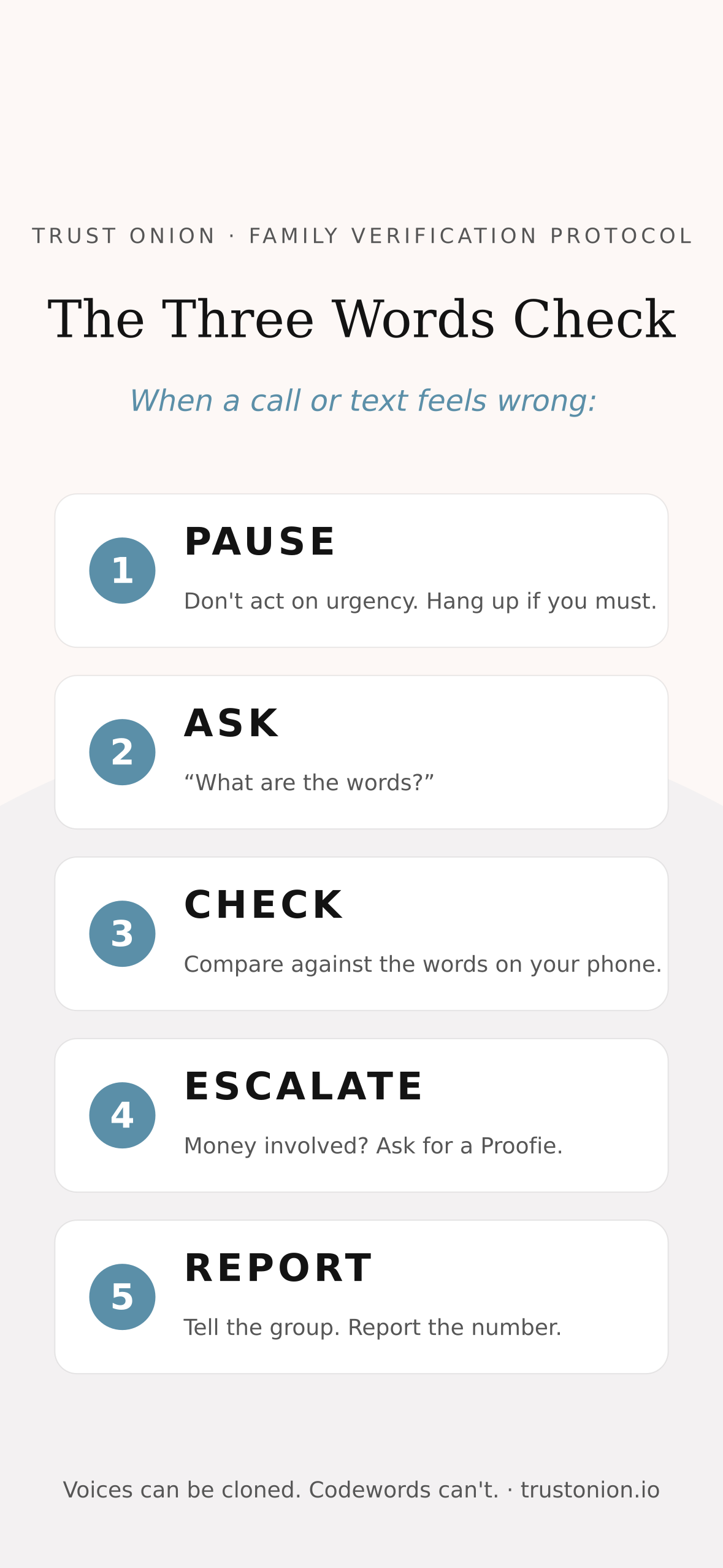
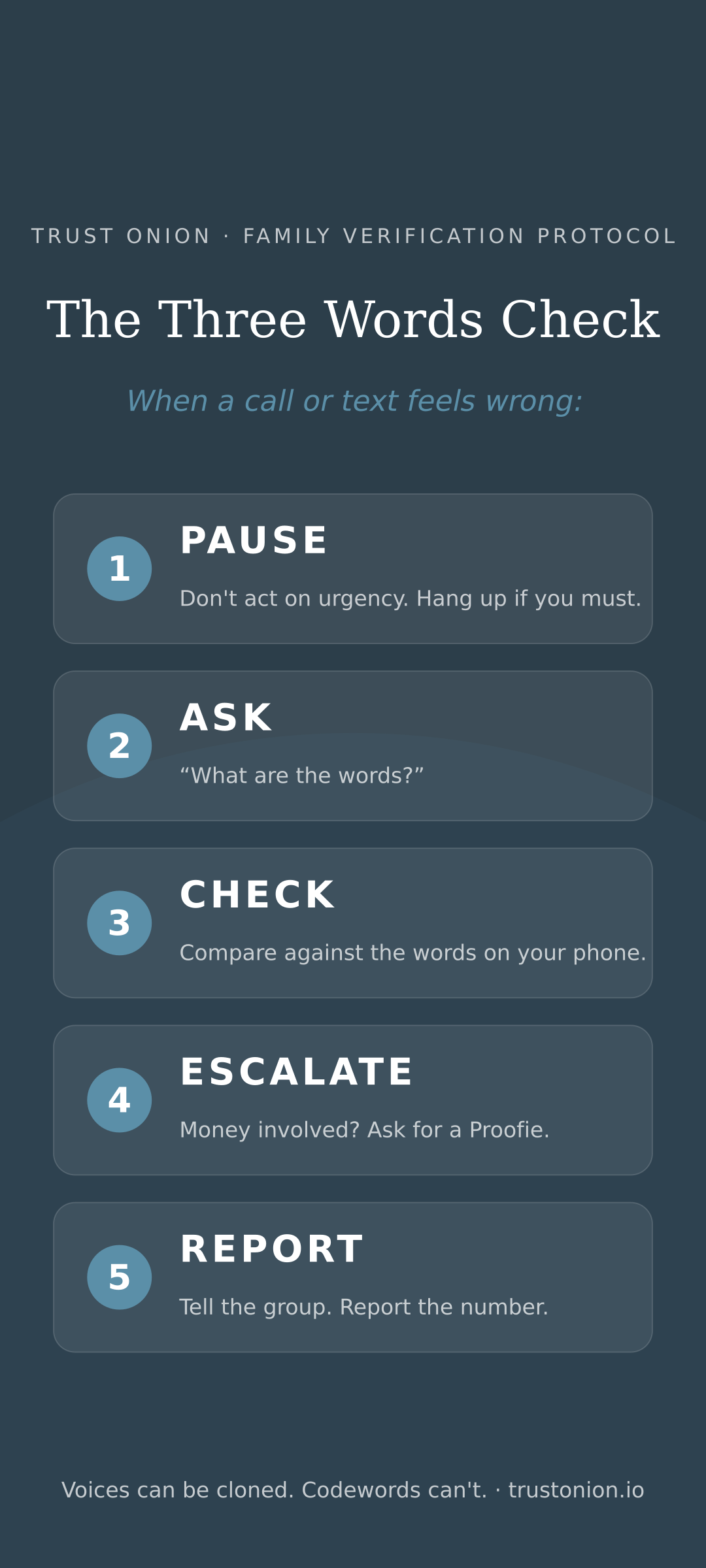
Verification only helps if it's remembered under pressure. Put the protocol where the pressure happens: on lock screens and next to landlines.
What is a family verification protocol?
It's an agreed plan every member of a family or group follows to confirm who they're really talking to before acting on a request. The Three Words Check uses three private, rotating codewords: when a call or text feels wrong, you ask "What are the words?" and only act if the answer matches the words on your own phone.
Isn't a single family safe word enough?
A single static safe word is better than nothing, but it has weaknesses: it can be overheard or leaked once and reused forever, family members forget it, and there's no way to prove it hasn't been compromised. Rotating codewords expire automatically, so yesterday's leak can't be used today.
Does this work against AI voice cloning?
Yes — that's the point. AI can clone a voice from a few seconds of audio, but it cannot know private codewords that rotate on a timer and never leave your devices. The protocol shifts verification from "does this sound like them?" (unreliable) to "do they know something only they could know right now?" (reliable).
What if the person is in a real emergency and can't check their phone?
Pause still applies. Real emergencies are handled by police, hospitals, and consulates — none of which demand gift cards or wire transfers on the spot. Hang up and call the person back on the number you already have for them, or call another family member who can reach them. If you cannot reach them, that does not authenticate the original call: the caller must still confirm your private Trust Onion Three Words. Verifying takes under a minute; a wire transfer is often irreversible in less.
Do grandparents or less tech-savvy relatives need a smartphone?
Each person who displays codewords needs the free app on an iPhone or Android phone. For relatives who can't or won't install it, agree that any request for money or personal information gets verified by calling them back on their known number — but remember that a failed callback does not prove the original caller was legitimate. The caller still needs to know the private Three Words; put the printable card by the landline as a reminder.
Can we use this for a club, team, or friend group instead of a family?
Yes. The protocol is identical for any trusted circle — a sports club, book club, volunteer group, or friend circle. Groups that handle shared money (a treasurer, trip organizer, or dues collector) benefit most, because "the treasurer changed bank accounts" is a favorite scam script.
Is the Three Words Check free? Can our school or bank share it?
Yes. The app is free with no account required, and this page, the printable card, and the wallpapers are free to share and distribute unmodified — in newsletters, branch handouts, senior-center sessions, or classroom materials — with attribution to this page.
No protocol guarantees you won't be scammed, and we won't claim this one does. The Three Words Check is honest about its boundaries:
- It only covers people in your group. A fake call from "your bank," "the IRS," or "tech support" isn't an impersonation of a family member — for those, hang up and call the organization back on the number printed on your card or statement.
- It depends on everyone actually running the check. The protocol fails silently if one family member decides "this time it's really them" and skips it. Practice it once, out loud, when nothing is wrong.
- A phone in a scammer's hands is a real risk. If a phone is stolen and unlocked, its codewords are visible. Proofie signing requires Face ID, fingerprint or device-passcode unlock; it is not a guarantee against a compromised phone or passcode.
- It can't recover money already sent. The protocol prevents; it doesn't undo. If money has moved, contact your bank immediately and file at ic3.gov — speed matters more than embarrassment.
- FBI Internet Crime Complaint Center (IC3), 2024 Internet Crime Report — reported fraud losses reached a record $16.6 billion in 2024, with adults over 60 losing nearly $5 billion, the most of any age group.
- FBI, Public Service Announcement I-120324-PSA — criminals use generative AI, including AI-generated audio of loved ones claiming a crisis, to commit fraud on a larger scale; the FBI itself recommends families "create a secret word or phrase" to verify identity.
- Federal Trade Commission, Scammers use AI to enhance their family emergency schemes — consumer alert on voice cloning in family-emergency scams and why calling back on a known number matters.
- Real incidents tracked on this site: AI scam case studies and voice clone scams in the news.
Schools, banks, senior centers, clubs, and reporters are welcome to share, reprint, or hand out this protocol and its materials unmodified, free of charge. Please credit it like this:
The Three Words Check — a free family verification protocol by Trust Onion.
https://trustonion.io/family-verification-protocol
Press inquiries: see our press page.
Set up the codewords in about 60 seconds
The protocol needs the codewords, and the codewords need the free app. Follow the family setup guide or the friends & club setup guide, then practice the check once at dinner — before anyone needs it for real.
Cite this page
The Three Words Check — Family Verification Protocol — Trust Onion, October 11, 2026. https://trustonion.io/family-verification-protocol